Blog post · Research
Why FIFO is (almost) all you need for cache eviction
LRU tries to rank everything. Production traces showed that caches need something simpler: reject one-hit objects quickly and delay promotion until it matters.
Cache eviction is usually presented as a ranking problem. LRU ranks objects by recency. LFU ranks them by frequency. More advanced algorithms combine several signals, adapt their parameters, and maintain increasingly sophisticated data structures to decide which object is least valuable.
For decades, the direction of progress seemed obvious: a more accurate ranking should produce a better cache.
Production workloads pointed us somewhere else. The dominant problem was not that caches ranked valuable objects poorly. It was that they spent too much time ranking objects with no value to rank.
The workload changed the question#
Across production cache traces, a large fraction of objects are requested once and never reused while they are resident in the cache.1 These objects are often called one-hit wonders. They consume space, displace useful data, and disappear without producing a single cache hit.
This effect is easy to underestimate. An object may appear twice in the full trace and therefore look reusable. But if its second request arrives long after any practical cache would have evicted the first copy, the cache experiences two separate one-hit objects. What matters is not reuse somewhere in the trace; it is reuse before eviction.
Once we looked at the workload this way, cache eviction stopped looking like one ranking problem. It became two filtering problems:
- Quick demotion: How quickly can the cache remove a new object that has shown no evidence of reuse?
- Lazy promotion: How long can the cache wait before rewarding an object that has been reused?
We described these principles in FIFO Can Be Better than LRU: The Power of Lazy Promotion and Quick Demotion. They explain why a simple FIFO queue can outperform policies designed to track the workload much more precisely.
Where LRU spends the wrong work#
LRU gives every new object the most privileged position in the cache: the head of the queue. A one-hit object must travel through the entire queue before it can be evicted. During a scan or burst of new traffic, many useless objects receive this protection at once and push out data that would have been reused. LRU demotes new objects too slowly.
LRU is also eager on a hit. Every access moves an object back to the head. In a concurrent cache, that move means synchronization, pointer updates, and cache coherence traffic. A popular object may be promoted thousands of times even though the first promotion already moved it far from eviction.
FIFO has the opposite behavior. New objects advance steadily toward eviction, so a one-hit object leaves after one pass through the queue. Hits do not change the global ordering, so the cache avoids mutations on its hottest path.
Plain FIFO goes too far: it will eventually evict even a frequently requested object. The useful design point lies just beyond it.
Start with FIFO, then spend the smallest possible amount of state on a second chance.
One bit of evidence#
The basic second-chance mechanism is almost embarrassingly small. A new object enters a FIFO queue with no evidence of reuse. A hit records one small piece of evidence—a bit or a tiny counter—but does not move the object. Only when the object approaches eviction does the cache decide whether that evidence earns more time.
This delay is important. At insertion, the cache knows nothing about the object. At the first hit, it knows the object was useful once. At eviction, it knows both that the object has been reused and that keeping it now requires evicting something else. The cache makes the expensive decision only when the decision matters.
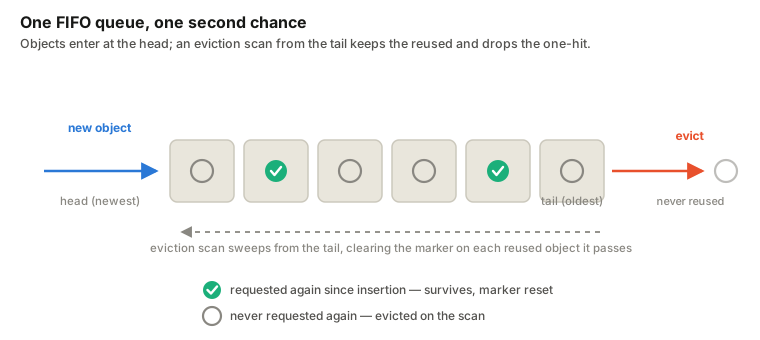
This idea produced two related algorithms: S3-FIFO2 and SIEVE3. They share the same workload insight, but spend their second chance differently.
S3-FIFO: filter first, protect later#
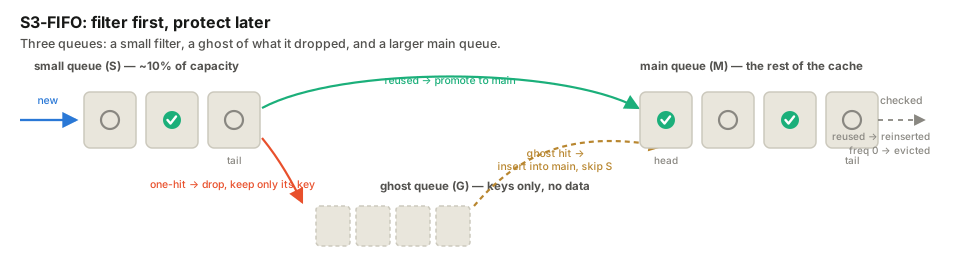
S3-FIFO uses three static FIFO queues:
- A small queue admits new objects and quickly filters out one-hit wonders.
- A main queue holds objects that have demonstrated reuse.
- A ghost queue stores only the keys of recently evicted objects, not their data.
Most new objects enter the small queue, which uses roughly 10% of the cache. When an object reaches its tail, an object with no reuse is evicted. If the object was requested again, it graduates to the main queue.
The ghost queue catches reuse that arrives just too late. When an evicted key is requested again, the cache now has evidence that the object is recurring, so it can bypass the small filter and enter the main queue directly.
The main queue provides longer-term protection without maintaining an exact recency order. Hits update a small frequency counter rather than moving an object immediately. At eviction time, the counter determines whether the object leaves or receives another turn.
The queues have different jobs: the small queue supplies quick demotion, the main queue supplies lazy promotion, and the ghost queue connects evidence across cache residencies.
SIEVE: leave the object where it is#
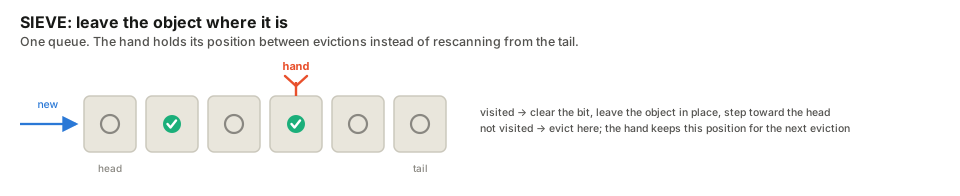
SIEVE reduces the same insight to one queue, one visited bit per object, and one moving hand.
New objects enter at the head. A hit sets the object's visited bit but does not move it. When the cache needs space, the hand examines eviction candidates. If an object has been visited, SIEVE clears the bit, leaves the object in place, and advances the hand. The first unvisited object is evicted.
The hand does not restart from the tail after every eviction. It remembers its position and continues from there the next time the cache needs space. This small detail makes SIEVE different from a conventional second-chance queue: objects survive in place rather than being reinserted at the head.
That means a hit never changes the queue. It performs no list operation and needs no lock on the global eviction order. The design is simple enough to add to an existing cache in a few lines, yet the parked hand prevents the repeated tail scans that would otherwise waste work.
| S3-FIFO | SIEVE | |
|---|---|---|
| Queue structure | Small, main, and ghost queues | One queue |
| Hit path | Update a tiny frequency counter | Set one visited bit |
| Second chance | Promote or reinsert at eviction | Clear the bit and leave the object in place |
| Main strength | Robust filtering across diverse workloads | Minimal implementation and synchronization |
Simpler is also faster#
These algorithms were designed from a workload observation, but their simplicity produces a second benefit: scalability.
Across 6,594 traces from 14 datasets, S3-FIFO achieved a lower miss ratio than each of 12 state-of-the-art algorithms in the comparison. On some traces it reduced LRU's miss ratio by as much as 72%. In a separate comparison, it matched LRU's hit ratio with roughly 46% less memory.
SIEVE, despite using less machinery, reduced ARC's miss ratio by up to 63.2% on skewed web workloads. Across the full evaluation, it was more consistently competitive than algorithms with substantially more metadata and adaptation logic.
The hit path is where the engineering difference becomes most visible. LRU must coordinate updates to a shared order on every hit. FIFO-based algorithms record local metadata and defer queue maintenance until eviction, which occurs far less often.
At 16 threads, S3-FIFO sustained about 6× the throughput of an optimized LRU implementation. Its sequential queue operations are also friendlier to flash, where random rewrites increase write amplification and wear. SIEVE was integrated into five production cache libraries with fewer than 20 lines of change on average, and its prototype achieved about 2× the throughput of an optimized 16-thread LRU.
This combination—lower miss ratios, fewer shared mutations, and small implementations—helped the algorithms move beyond papers into production systems and open-source cache libraries.
Why “almost” matters#
The argument is not that plain FIFO is universally optimal. No online eviction algorithm wins on every workload, and pure FIFO can discard a hot object simply because it is old.
The claim is that FIFO is a better starting point than we gave it credit for. Once a cache can quickly discard one-hit wonders and give reused objects a carefully delayed second chance, much of the value attributed to sophisticated ranking appears without the ranking.
This changes how I think about cache design:
- Count metadata work as well as misses. A policy that saves a few misses by mutating a global list on every request may lose at the system level.
- Separate admission from protection. New objects have not earned the same treatment as objects with demonstrated reuse.
- Delay decisions until they matter. Eviction time contains more evidence than insertion time or the first hit.
- Make complexity justify itself. Every queue, counter, parameter, and lock should correspond to a workload behavior we can measure.
Footnotes
-
This one-hit-wonder effect is quantified across the production traces in the S3-FIFO study. On many web and key-value workloads, most objects receive no second request during their effective cache lifetime, even when they reappear much later in the complete trace. ↩
-
Juncheng Yang, Yazhuo Zhang, Ziyue Qiu, Yao Yue, and K. V. Rashmi. "FIFO queues are all you need for cache eviction." In Proceedings of the 29th ACM Symposium on Operating Systems Principles (SOSP '23), 2023. Project page: https://s3fifo.com. ↩
-
Yazhuo Zhang, Juncheng Yang, Yao Yue, Ymir Vigfusson, and K. V. Rashmi. "SIEVE is Simpler than LRU: an Efficient Turn-Key Eviction Algorithm for Web Caches." In Proceedings of the 21st USENIX Symposium on Networked Systems Design and Implementation (NSDI '24), 2024. Project page: https://sieve-cache.com. ↩