Storage & ML systems
I measure how systems behave, then make the common path simpler, faster, and more efficient.
Latest post07.23.26
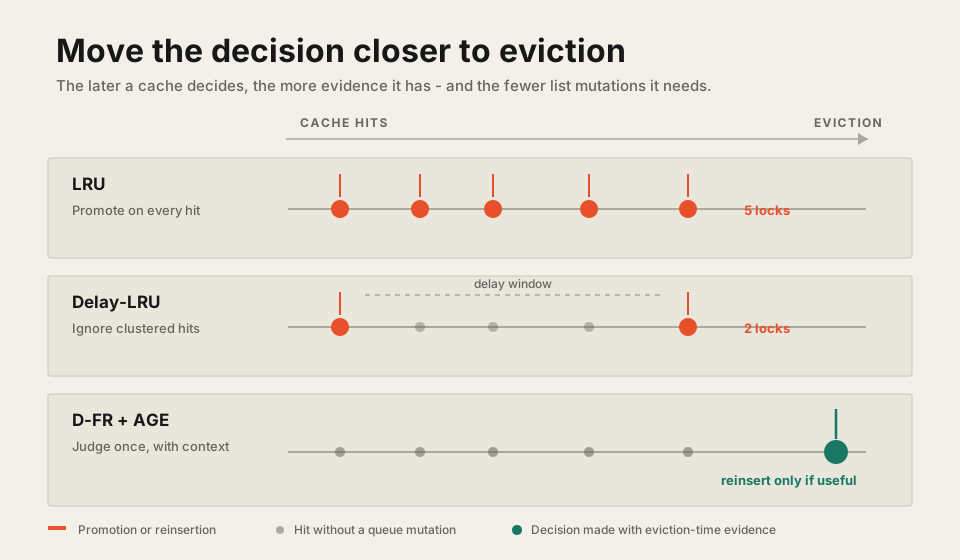
Your LRU cache is working too hard.
The archive · 2026
- A paper reproducibility agent: PDF in, report out We turned the MLSys'26 AE agent's core into a standalone paper reproducibility agent. Give it a paper PDF; it finds the repo, installs and runs it, and adjudicates the paper's claims.
- Same open weights, prompt-cache lifetimes from seconds to a day Across 23 providers serving two open-weight models, prompt-cache retention ranged from under 30 seconds to more than a day. Even for the same model, the serving stack determined the cache.
- Deploying an artifact-evaluation agent at MLSys'26 We deployed a tool-using agent on the MLSys'26 AE HotCRP as a real reviewer. Across its completed reviews, it usually scored within one point of its human co-reviewers.
- Measure first, design second AI is making solutions cheaper, but it is not making important problems easier to find. Measurement is how systems research discovers what matters.
- Proprietary prompt caches expire in minutes, not hours — cheap per token doesn't mean a cheap bill OpenAI, Gemini, Anthropic, and xAI all cache your prompt prefix — but the probe that caught open-weight backends holding prefixes for hours catches the big proprietary APIs letting go in 5 to 30 minutes.
- Authorship inflation at OSDI: counting papers two ways OSDI author lists have more than doubled since 1994. Whether the field's most prolific authors are actually publishing more depends on whether a paper counts as one, or as one divided by its author count.
- Make model precision elastic MorphServe temporarily converts selected model layers into KV-cache headroom when traffic spikes, then restores full precision when the pressure passes.
- Why FIFO is (almost) all you need for cache eviction LRU tries to rank everything. Production traces showed that caches need something simpler: reject one-hit objects quickly and delay promotion until it matters.
- What I look for in systems research students I am looking for curious, persistent students who want to build real systems. Here is what the work requires and how to write an email I will read carefully.
Computer Systems Researcher and Educator